
 Explore BioBoost Labs
The Nervous System
How the brain’s messengers, growth factors, and stress circuits work — and what the research literature actually documents about the peptides studied alongside them.
The system at a glance
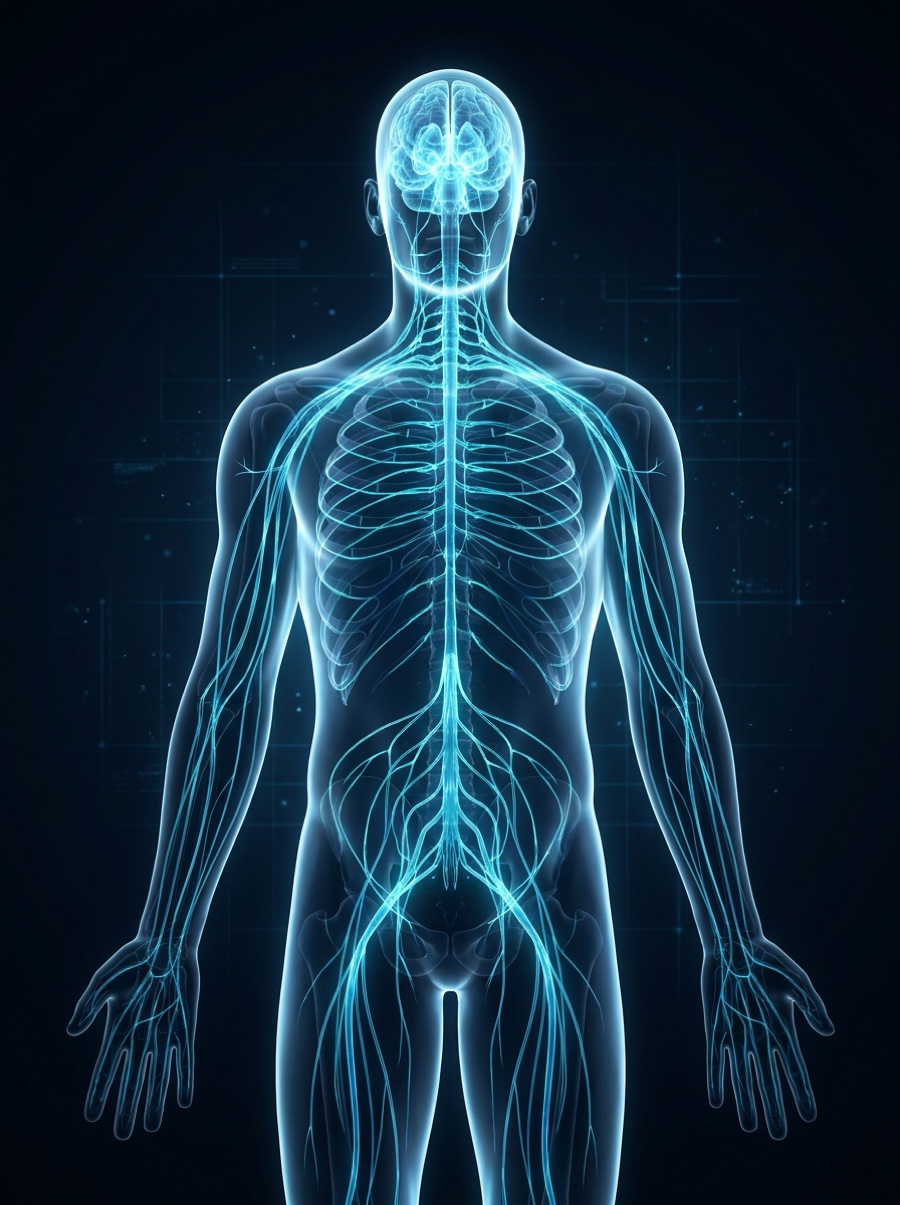
The nervous system is a network of roughly 86 billion neurons that communicate through electrical impulses and chemical signals, coordinated by supporting glial cells. Beyond moment-to-moment signaling, the brain constantly remodels itself: synapses strengthen or weaken, and the survival and growth of neurons depend on a family of proteins called neurotrophins. Overlaid on this are slower regulatory systems that govern arousal, stress reactivity, mood, and the daily sleep-wake cycle. Much of the peptide research below targets these regulatory layers rather than fast synaptic transmission.
How it signals
Neurons talk using neurotransmitters such as glutamate (the brain’s main excitatory signal) and GABA (its main inhibitory brake), acting on receptors like the GABA-A and NMDA receptors. A separate class of longer-acting messengers — neuropeptides and neuromodulators — tune the gain of these circuits rather than carrying the primary message. Growth factors including brain-derived neurotrophic factor (BDNF) and nerve growth factor (NGF) support plasticity and neuronal survival by binding receptors such as TrkB. The compounds surveyed here are studied for how they interact with these modulatory and neurotrophic pathways, largely in cell and animal models.
Research peptides studied in this system
Each card summarizes the documented mechanism, what was actually studied and in what model, and how strong the evidence is. These are descriptions of laboratory research — not recommendations, and not evidence of benefit in humans. According to research indexed in PubMed:
What we don’t know — and the risks
Honest limits matter as much as the mechanisms. For this system specifically:
- Most mechanistic evidence for Semax, Selank, DSIP, and Pinealon comes from cell and rodent models and from a relatively narrow, largely Russian research literature — animal findings do not reliably predict human effects.
- GABAergic compounds such as Selank act on the same receptor system as sedatives; independent pharmacology reviews raise dependence, withdrawal, and quality-control concerns for peptides sold as dietary supplements.
- None of these peptides is an FDA-approved treatment for anxiety, cognitive, or sleep conditions in the United States; described effects are mechanistic, not endorsements of use.
- The nervous system is tightly regulated by feedback loops (stress axis, sleep-wake cycle); pushing on one node can produce non-linear or dose-inverted effects, as several studies here observed.
- This page covers documented mechanisms only. It provides no dosing, timing, administration, or protocol information — those questions belong with a qualified physician.
- For any compound above, an available receptor or biomarker mechanism is not proof of a clinical benefit; several targets (e.g., DSIP’s receptor, intranasal oxytocin’s central delivery) remain unresolved in the literature.
Responsible understanding
◆ This is education, not medical advice
This page is educational and describes what has been studied in laboratory and clinical research. It is not medical advice, and these materials are for research use only — not for human or veterinary use. Timing, administration, and whether anything is used at all are clinical decisions that belong with a licensed physician overseeing your care; we take no position on them. Science and regulation evolve; verify anything important against the primary sources below.
Sources
Based on articles retrieved from PubMed. Follow each link to the original paper.
- Dolotov OV, Karpenko EA, Seredenina TS, et al. Semax, an analogue of adrenocorticotropin (4-10), binds specifically and increases levels of brain-derived neurotrophic factor protein in rat basal forebrain. Journal of Neurochemistry. 2006;J Neurochem. 2006;97 Suppl 1:82-6. DOI
- Dolotov OV, Karpenko EA, Inozemtseva LS, et al. Semax, an analog of ACTH(4-10) with cognitive effects, regulates BDNF and trkB expression in the rat hippocampus. Brain Research. 2006;Brain Res. 2006;1117(1):54-60. DOI
- Agapova TY, Agniullin YV, Shadrina MI, et al. Neurotrophin gene expression in rat brain under the action of Semax, an analogue of ACTH 4-10. Neuroscience Letters. 2007;Neurosci Lett. 2007;417(2):201-5. DOI
- Vyunova TV, Andreeva L, Shevchenko K, Myasoedov N. Peptide-based Anxiolytics: The Molecular Aspects of Heptapeptide Selank Biological Activity. Protein and Peptide Letters. 2018;Protein Pept Lett. 2018;25(10):914-923. DOI
- Zozulia AA, Neznamov GG, Siuniakov TS, et al. Efficacy and possible mechanisms of action of a new peptide anxiolytic selank in the therapy of generalized anxiety disorders and neurasthenia. Zhurnal Nevrologii i Psikhiatrii imeni S.S. Korsakova. 2008;Zh Nevrol Psikhiatr Im S S Korsakova. 2008;108(4):38-48. PubMed
- Doyno CR, White CM. Sedative-Hypnotic Agents That Impact Gamma-Aminobutyric Acid Receptors: Focus on Flunitrazepam, Gamma-Hydroxybutyric Acid, Phenibut, and Selank. Journal of Clinical Pharmacology. 2021;J Clin Pharmacol. 2021;61 Suppl 2:S114-S128. DOI
- Khvatova EM, Samartzev VN, Zagoskin PP, Prudchenko IA, Mikhaleva II. Delta sleep inducing peptide (DSIP): effect on respiration activity in rat brain mitochondria and stress protective potency under experimental hypoxia. Peptides. 2003;Peptides. 2003;24(2):307-11. DOI
- Bobyntsev II, Kryukov AA, Belykh AE, Dudka VT. Effect of Delta Sleep-Inducing Peptide on Functional State of Hepatocytes in Rats During Restraint Stress. Bulletin of Experimental Biology and Medicine. 2016;Bull Exp Biol Med. 2016;160(4):421-4. DOI
- Kozina LS. Investigation of antihypoxic properties of short peptides. Advances in Gerontology (Uspekhi Gerontologii). 2008;Adv Gerontol. 2008;21(1):61-7. PubMed
- Umnov RS, Lin’kova NS, Khavinson VKh. Neuroprotective effects of peptides bioregulators in people of various age. Advances in Gerontology (Uspekhi Gerontologii). 2013;Adv Gerontol. 2013;26(4):671-8. PubMed
- Churchland PS, Winkielman P. Modulating social behavior with oxytocin: how does it work? What does it mean? Hormones and Behavior. 2011;Horm Behav. 2012;61(3):392-9. DOI
- Mairesse J, Gatta E, Reynaert ML, et al. Activation of presynaptic oxytocin receptors enhances glutamate release in the ventral hippocampus of prenatally restraint stressed rats. Psychoneuroendocrinology. 2015;Psychoneuroendocrinology. 2015;62:36-46. DOI
- Tom NC, Assinder SJ. Oxytocin: recent developments. Biomolecular Concepts. 2010;Biomol Concepts. 2010;1(5-6):367-80. DOI
Research-use-only educational content. Nothing here is medical, dosing, timing, or treatment advice.