
Muscle & Performance

Body & Peptide Science · System 02

Muscle & Performance

How skeletal muscle grows, repairs, and fuels itself — and what the research literature actually documents about the compounds studied in this space.
6 compounds studied10 primary sourcesResearch use only
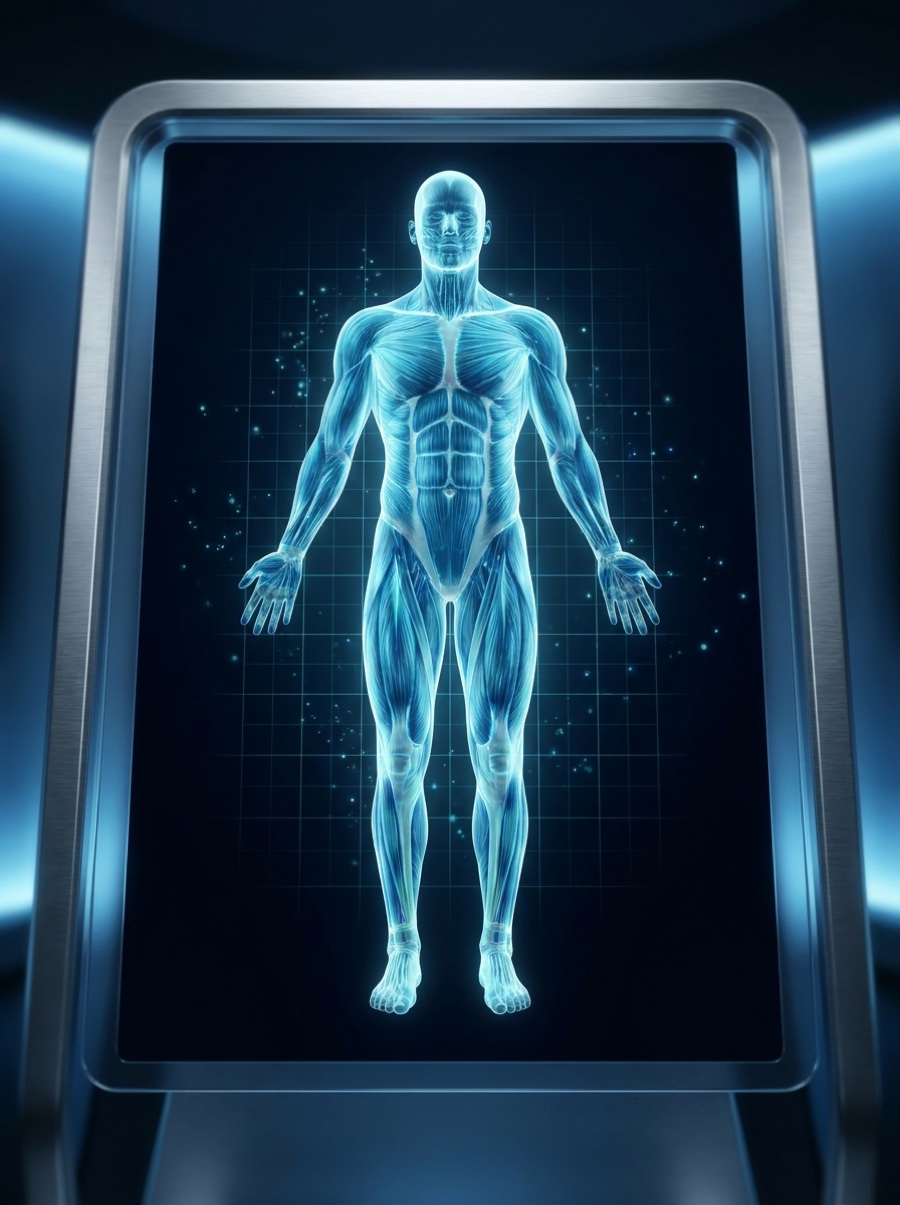
Anatomical bio-scan of the Muscle & Performance
01

The system at a glance

Skeletal muscle is built from long multinucleated fibers that thicken (hypertrophy) or shrink (atrophy) depending on the balance between protein synthesis and breakdown. Growth signals switch on the PI3K/Akt/mTOR pathway to make new muscle protein, while resident muscle stem cells (satellite cells) supply fresh nuclei needed for repair and enlargement. Overlaying this is the growth-hormone (GH) axis and the mitochondria that generate the energy for contraction and exercise adaptation. Most compounds grouped here act on one of these levers: the GH/IGF-1 signal, satellite-cell activity, or mitochondrial and fat-energy metabolism.

02

How it signals

The key messengers are growth hormone (released in pulses from the pituitary) and insulin-like growth factor 1 (IGF-1), which drives muscle protein synthesis through the PI3K/Akt/mTOR and Akt/GSK3 pathways. Pituitary GH release is controlled by two receptors: the GHRH receptor (targeted by GHRH-analogs such as sermorelin and CJC-1295) and the growth-hormone-secretagogue / ghrelin receptor (targeted by ipamorelin). Satellite cells respond to IGF-1 by proliferating and differentiating, while mitochondrial signaling peptides and NAD-related enzymes (such as NNMT) tune cellular energy, AMPK activity, and fat oxidation.
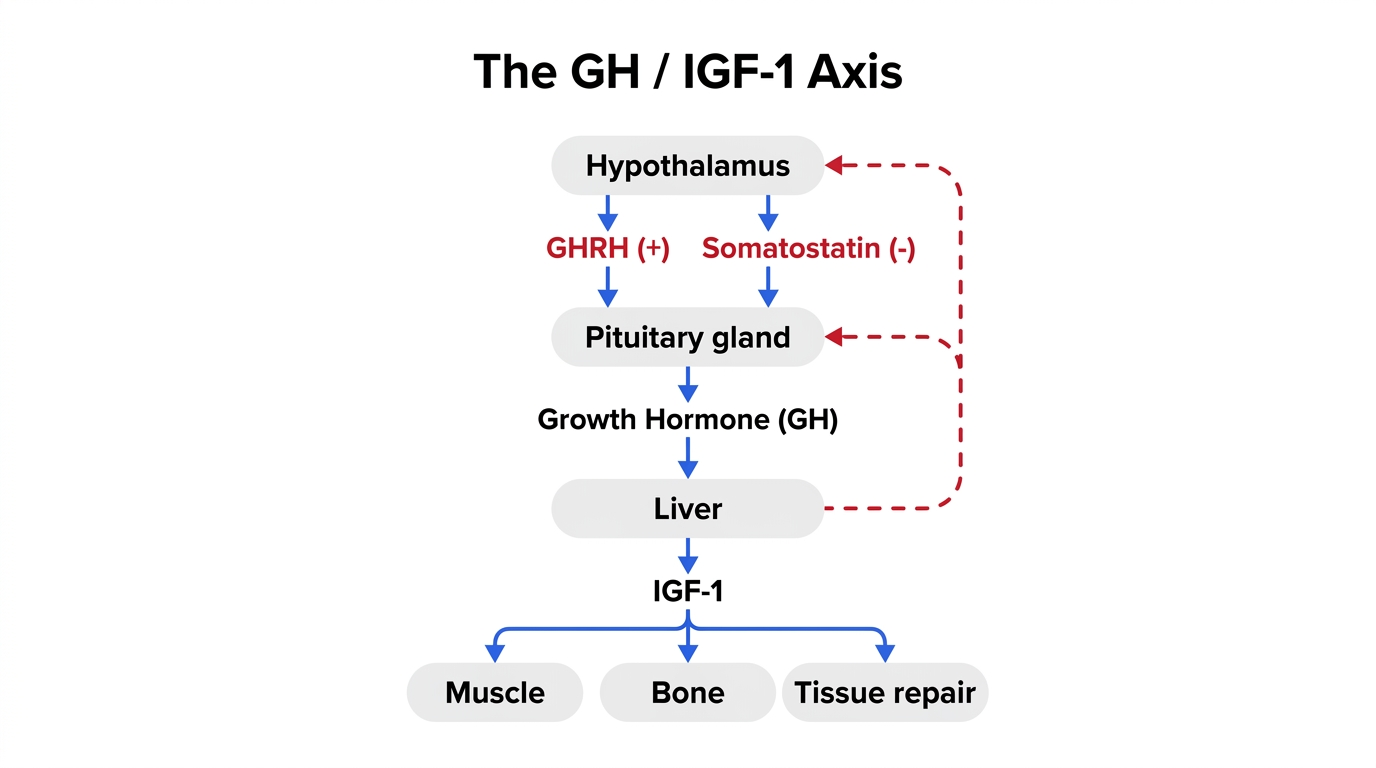
The GH/IGF-1 axis: hypothalamus GHRH and somatostatin regulate pituitary growth hormone, which drives hepatic IGF-1 to muscle, bone, and tissue
The GH / IGF-1 axis — the hypothalamus (GHRH and somatostatin) regulates pituitary growth-hormone release, which drives hepatic IGF-1 and downstream signaling to muscle, bone, and tissue repair, with negative feedback.
03

Research peptides studied in this system

Each card summarizes the documented mechanism, what was actually studied and in what model, and how strong the evidence is. These are descriptions of laboratory research — not recommendations, and not evidence of benefit in humans. According to research indexed in PubMed:

IGF-1 LR3long-acting IGF-1 analogPreclinical (mechanism only; no human LR3 data)
Documented mechanism
A modified IGF-1 that resists its binding proteins and so signals longer; native IGF-1 drives muscle-fiber hypertrophy through the PI3K/Akt/mTOR and Akt/GSK3 pathways and recruits satellite cells toward differentiation (rather than expanding their proliferative pool). 123
What was actually studied
IGF-1’s hypertrophic signaling is documented in cultured myotubes and in transgenic mice overexpressing a local muscle IGF-1 isoform, which showed larger fibers and heavier bodies; the LR3 analog itself has not been evaluated in controlled human muscle trials.
Evidence tier
Mechanism of native IGF-1 is well characterized preclinically, but the LR3 form lacks human efficacy or safety data for muscle growth.
CJC-1295 (no-DAC) + IpamorelinGHRH-analog + ghrelin-receptor GH secretagogueEmerging / mixed
Documented mechanism
CJC-1295 is a GHRH analog that stimulates pituitary GH release via the GHRH receptor; ipamorelin is a selective growth-hormone secretagogue acting on the separate ghrelin receptor, so the pair is intended to amplify pulsatile GH and downstream IGF-1. 45
What was actually studied
In a randomized human trial, CJC-1295 raised GH and IGF-1 for days — but that trial used the long-acting DAC form, not the shorter-acting no-DAC version; ipamorelin’s GH-releasing effect is shown in rodents. The specific no-DAC + ipamorelin combination has not been tested in controlled muscle or body-composition trials.
Evidence tier
GH/IGF-1 stimulation is documented, but human evidence for this exact combination and for muscle outcomes is absent.
SermorelinGHRH(1-29) analogEmerging
Documented mechanism
A truncated GHRH(1-29) peptide that binds the pituitary GHRH receptor to stimulate the body’s own growth-hormone secretion, indirectly raising IGF-1. 64
What was actually studied
In randomized trials in growth-hormone-deficient children, sermorelin (GHRH 1-29) increased growth velocity but was less effective than recombinant GH, and IGF-1 rose transiently then returned toward baseline; effects on muscle or performance in healthy adults have not been established.
Evidence tier
GH-raising action is confirmed in humans, but muscle/performance benefit in healthy adults is unstudied and the pediatric effect was weaker than GH itself.
MOTS-cmitochondrial-derived peptideEmerging
Documented mechanism
A 16-amino-acid peptide encoded in mitochondrial DNA that targets skeletal muscle, inhibits the folate/purine cycle and activates AMPK, shifting cells toward glucose use and metabolic stress adaptation. 78
What was actually studied
In mice, MOTS-c improved insulin sensitivity, reduced diet-induced obesity, and enhanced physical performance across ages; in humans it is induced in muscle and blood by exercise, but there are no therapeutic human trials.
Evidence tier
Strong rodent metabolic and performance data plus a documented human exercise-response, but no controlled human treatment evidence.
5-Amino-1MQNNMT enzyme inhibitorPreclinical / early
Documented mechanism
A small-molecule methylquinolinium that inhibits nicotinamide N-methyltransferase (NNMT), an enzyme in NAD-related metabolism; blocking it is proposed to raise cellular NAD and SAM and reduce fat storage. 9
What was actually studied
In cultured adipocytes and diet-induced-obese mice, NNMT inhibitors of this chemical class suppressed lipogenesis, lowered body weight and fat mass, and shifted energy metabolites — all preclinical; no human data exist.
Evidence tier
Evidence is limited to cell-culture and mouse studies; human safety, dosing, and muscle effects are undefined.
AOD-9604GH fragment (176-191) lipolytic peptidePreclinical / early
Documented mechanism
A synthetic fragment of the C-terminus of human growth hormone studied for fat metabolism; it appears to promote lipolysis and fat oxidation without binding the GH receptor (and, consistent with that, is not expected to raise IGF-1). 10
What was actually studied
In obese and lean mice, AOD-9604 reduced body-weight gain, increased fat oxidation and lipolysis — without the glucose-raising effects of full GH; rigorous human muscle or body-composition efficacy data are lacking.
Evidence tier
Body-composition effects are documented only in rodents; the compound targets fat energy rather than muscle growth directly, and human evidence is limited.
04

What we don’t know — and the risks

Honest limits matter as much as the mechanisms. For this system specifically:

  • Compounds that stimulate the GH axis (CJC-1295, ipamorelin, sermorelin) raise GH and IGF-1; sustained supraphysiologic GH/IGF-1 signaling is linked to insulin resistance, fluid retention, and tissue overgrowth in GH-excess states — not characterized for these peptides at self-administered exposures.
  • IGF-1 LR3 resists binding proteins and signals systemically; no controlled human trials define a safe muscle-building exposure, and persistent mitogenic signaling raises theoretical cell-proliferation concerns.
  • Most muscle and performance findings here come from rodent, cell-culture, or non-muscle endpoints; extrapolation to human muscle mass, strength, or body composition is unproven.
  • The CJC-1295 + ipamorelin combination has not been evaluated in controlled trials for efficacy or long-term safety, and the widely referenced human CJC-1295 data used the long-acting DAC form, not the no-DAC version.
  • 5-Amino-1MQ and AOD-9604 muscle/metabolic evidence is essentially preclinical; human effect sizes, dosing, and long-term safety are undefined.
  • Research-grade peptide identity, purity, and dose are not guaranteed, and long-term outcomes for all of these compounds remain unstudied.
05

Responsible understanding

◆ This is education, not medical advice

This page is educational and describes what has been studied in laboratory and clinical research. It is not medical advice, and these materials are for research use only — not for human or veterinary use. Timing, administration, and whether anything is used at all are clinical decisions that belong with a licensed physician overseeing your care; we take no position on them. Science and regulation evolve; verify anything important against the primary sources below.

06

Sources

Based on articles retrieved from PubMed. Follow each link to the original paper.

  1. Rommel C et al. Mediation of IGF-1-induced skeletal myotube hypertrophy by PI(3)K/Akt/mTOR and PI(3)K/Akt/GSK3 pathways. Nature Cell Biology. 2001;3(11):1009-13. DOI
  2. Mouly V et al. The mitotic clock in skeletal muscle regeneration, disease and cell mediated gene therapy. Acta Physiologica Scandinavica. 2005;184(1):3-15. DOI
  3. Gao B et al. Changes in Skeletal Muscle and Body Weight on Sleeping Beauty Transposon-Mediated Transgenic Mice Overexpressing Pig mIGF-1. Biochemical Genetics. 2018;56(4):341-355. DOI
  4. Teichman SL et al. Prolonged stimulation of growth hormone (GH) and insulin-like growth factor I secretion by CJC-1295, a long-acting analog of GH-releasing hormone, in healthy adults. The Journal of Clinical Endocrinology and Metabolism. 2006;91(3):799-805. DOI
  5. Johansen PB et al. Ipamorelin, a new growth-hormone-releasing peptide, induces longitudinal bone growth in rats. Growth Hormone & IGF Research. 1999;9(2):106-13. DOI
  6. Chen RG et al. A comparative study of growth hormone (GH) and GH-releasing hormone(1-29)-NH2 for stimulation of growth in children with GH deficiency. Acta Paediatrica Supplement. 1993;388:32-5. DOI
  7. Lee C et al. The mitochondrial-derived peptide MOTS-c promotes metabolic homeostasis and reduces obesity and insulin resistance. Cell Metabolism. 2015;21(3):443-54. DOI
  8. Reynolds JC et al. MOTS-c is an exercise-induced mitochondrial-encoded regulator of age-dependent physical decline and muscle homeostasis. Nature Communications. 2021;12(1):470. DOI
  9. Neelakantan H et al. Selective and membrane-permeable small molecule inhibitors of nicotinamide N-methyltransferase reverse high fat diet-induced obesity in mice. Biochemical Pharmacology. 2017;147:141-152. DOI
  10. Heffernan MA et al. Increase of fat oxidation and weight loss in obese mice caused by chronic treatment with human growth hormone or a modified C-terminal fragment. International Journal of Obesity and Related Metabolic Disorders. 2001;25(10):1442-9. DOI
Body & Peptide Science · Muscle & Performance · Draft for review
Research-use-only educational content. Nothing here is medical, dosing, timing, or treatment advice.
For research use only — not for human consumption, and not for diagnosing, treating, curing, or preventing any disease or condition, or making any medical claim. BioBoost Research is an educational resource. Science and regulation are evolving, and the information here may be incomplete, become outdated, or contain errors. Nothing here is medical, legal, or dosing advice — always verify against primary sources and consult a qualified professional. All information reflects facts as best known to BioBoost Research. Full disclaimer →

On clinical data and dosing: Any clinical trials, data, or dosing figures referenced anywhere on this site were conducted in controlled settings under qualified professional and physician oversight, and are shown for informational and educational purposes only — never as guidance. BioBoost Research makes no claim that the same outcome or safety profile would apply to any compound, person, or context. Research and educational use only · 21+.

Read the full Disclaimer →