
 Explore BioBoost Labs
Metabolic & Energy
How gut and pancreatic hormone receptors, plus the cell’s own energy machinery, are studied in the research literature. Education only, not medical advice.
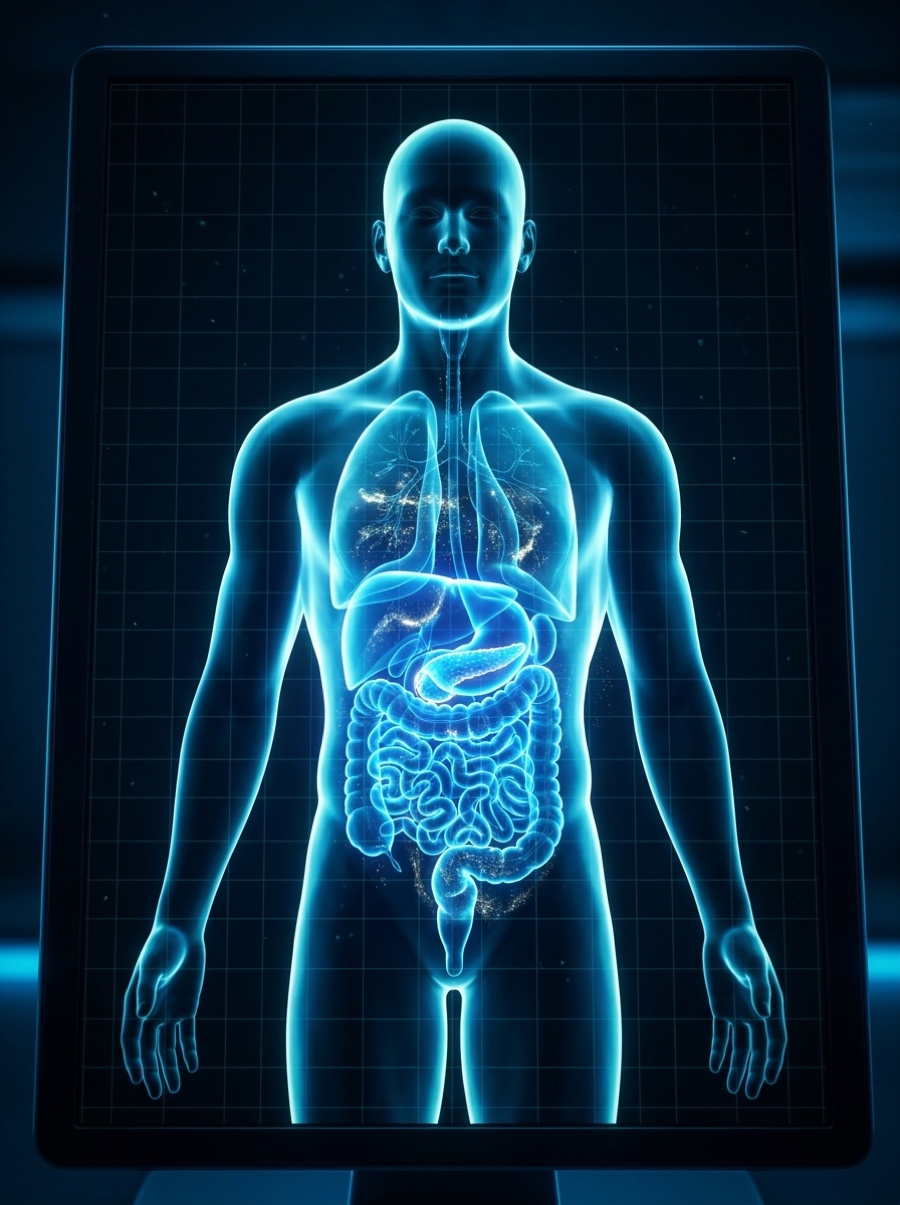
The system at a glance
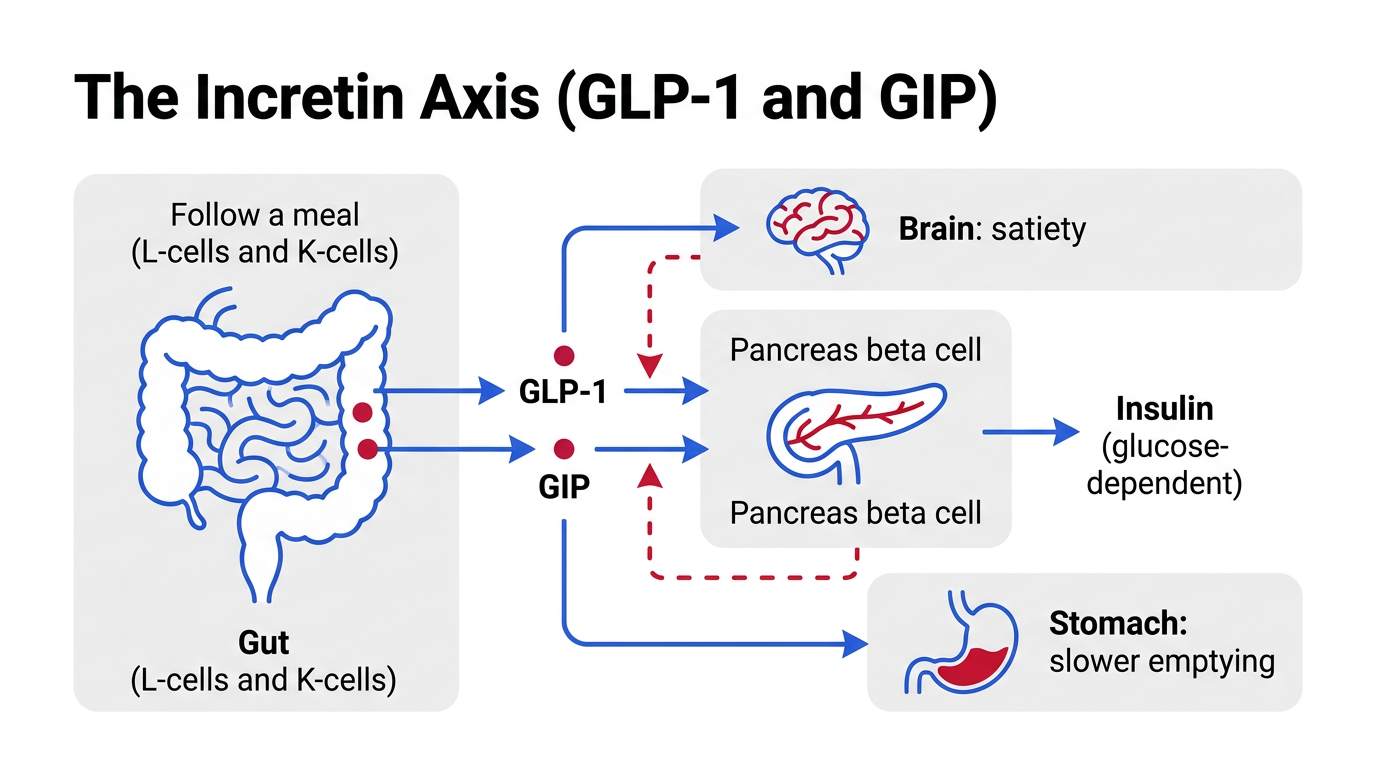
Every meal sets off a cascade of chemical messengers. Hormones released from the gut and pancreas tell the brain you are full, tell the stomach to slow down, and tell the pancreas to fine-tune insulin and glucagon so blood sugar stays in a narrow band. Deeper inside, mitochondria and the redox cofactor NAD+ run the machinery that actually turns fuel into usable energy. The compounds on this page are research tools grouped by where they act on that map: the incretin and amylin receptor signals that coordinate appetite and glucose, and the mitochondrial and enzyme pathways that govern how cells store versus burn fuel. This page describes what the peer-reviewed literature documents about their mechanisms and the models they were studied in. It is strictly educational and describes no protocol, dose, or use.
How it signals
Two conversations run in parallel. The first is hormonal: incretins (GLP-1, GIP, glucagon) and amylin are messengers that surge after eating and act on receptors in the pancreas, gut, and brain to shape insulin release, gastric emptying, and the sensation of fullness. Receptor engineers have learned to build single, dual, and triple-receptor research peptides that pull several of these levers at once. The second conversation is intracellular: enzymes like NNMT, mitochondrial-derived peptides like MOTS-c, and the NAD+ cofactor pool set how efficiently a cell burns fuel versus stores it as fat. Studying either conversation is how researchers map metabolism at the level of mechanism.
Research peptides studied in this system
Each card summarizes the documented mechanism, what was actually studied and in what model, and how strong the evidence is. These are descriptions of laboratory research — not recommendations, and not evidence of benefit in humans. According to research indexed in PubMed:
What we don’t know — and the risks
Honest limits matter as much as the mechanisms. For this system specifically:
- This page is educational and describes mechanisms and research models only. It is not medical advice and contains no dosing, timing, protocol, or how-to guidance.
- All compounds here are for research use only (RUO). Several — including AOD-9604, 5-Amino-1MQ, MOTS-c, and lipotropic combinations — have evidence limited largely to cell or animal models, and animal findings often fail to translate to humans.
- For the incretin and amylin receptor classes, note that engaging these pathways affects gastric emptying, appetite, and glucose regulation; the literature also documents gastrointestinal effects and unresolved mechanistic questions (for example, GIP’s role in humans).
- Evidence tiers on this page (l = lower / m = moderate / h = higher) reflect the maturity and consistency of the published mechanism, not a safety rating and not an endorsement of any use.
- Nothing here should be read as a claim that any compound diagnoses, treats, cures, or prevents disease.
Responsible understanding
◆ This is education, not medical advice
This page is educational and describes what has been studied in laboratory and clinical research. It is not medical advice, and these materials are for research use only — not for human or veterinary use. Timing, administration, and whether anything is used at all are clinical decisions that belong with a licensed physician overseeing your care; we take no position on them. Science and regulation evolve; verify anything important against the primary sources below.
Sources
Based on articles retrieved from PubMed. Follow each link to the original paper.
- Newsome PN, Ambery P Incretins (GLP-1 receptor agonists and dual/triple agonists) and the liver Journal of Hepatology. 2023;J Hepatol. 2023;79(6):1557-1565. DOI
- Drucker DJ Mechanisms of Action and Therapeutic Application of Glucagon-like Peptide-1 Cell Metabolism. 2018;Cell Metab. 2018;27(4):740-756. DOI
- Kawai T, Sun B, Yoshino H, et al. Structural basis for GLP-1 receptor activation by LY3502970, an orally active nonpeptide agonist Proceedings of the National Academy of Sciences USA. 2020;Proc Natl Acad Sci USA. 2020;117(47):29959-29967. DOI
- Baggio LL, Drucker DJ Biology of incretins: GLP-1 and GIP. Gastroenterology. 2007;132(6):2131-57. DOI
- Pullman J, Darsow T, Frias JP Pramlintide in the management of insulin-using patients with type 2 and type 1 diabetes Vascular Health and Risk Management. 2006;Vasc Health Risk Manag. 2006;2(3):203-212. DOI
- Heffernan M, Summers RJ, Thorburn A, et al. The effects of human GH and its lipolytic fragment (AOD9604) on lipid metabolism following chronic treatment in obese mice and beta(3)-AR knock-out mice Endocrinology. 2001;Endocrinology. 2001;142(12):5182-5189. DOI
- Neelakantan H, Vance V, Wetzel MD, et al. Selective and membrane-permeable small molecule inhibitors of nicotinamide N-methyltransferase reverse high fat diet-induced obesity in mice Biochemical Pharmacology. 2017;Biochem Pharmacol. 2017;147:141-152. DOI
- Zheng Y, Wei Z, Wang T MOTS-c: A promising mitochondrial-derived peptide for therapeutic exploitation Frontiers in Endocrinology. 2023;Front Endocrinol (Lausanne). 2023;14:1120533. DOI
- Mills KF, Yoshida S, Stein LR, et al. Long-Term Administration of Nicotinamide Mononucleotide Mitigates Age-Associated Physiological Decline in Mice Cell Metabolism. 2016;Cell Metab. 2016;24(6):795-806. DOI
- Fardet A New hypotheses for the health-protective mechanisms of whole-grain cereals: what is beyond fibre? Nutrition Research Reviews. 2010;Nutr Res Rev. 2010;23(1):65-134. DOI
Research-use-only educational content. Nothing here is medical, dosing, timing, or treatment advice.