
 Explore BioBoost Labs
Bio S/1
A single-target engineered incretin peptide built to selectively engage the GLP-1 receptor, used as a research reference for glucose-dependent insulin signaling.
One class, three reaches
Bio S/1, Bio T/2 and Bio R/3 are all incretin-class research peptides. What separates them is simple — how many of these three receptors each one engages.
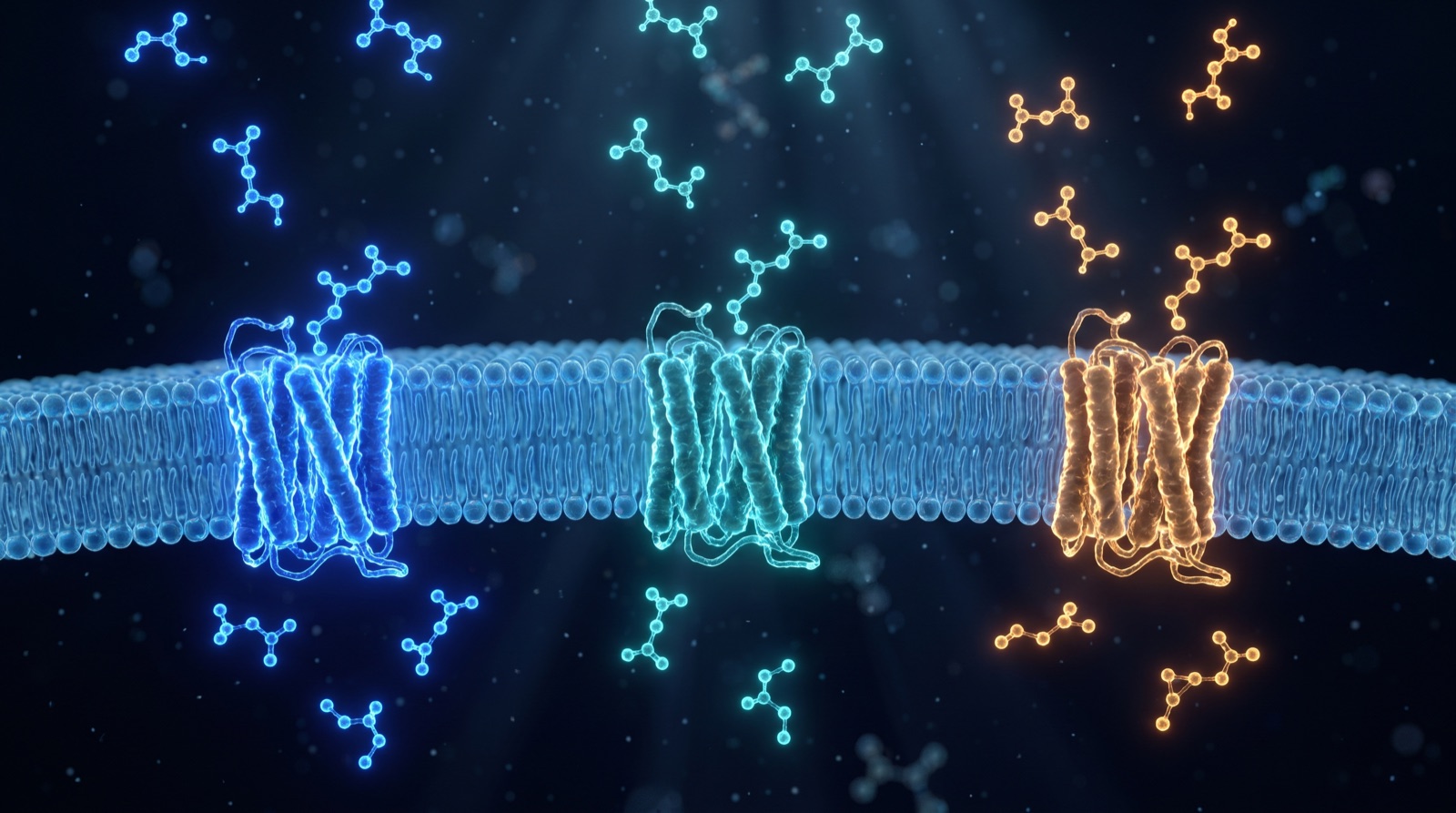
GLP-1 receptor agonist
GIP / GLP-1 co-agonist
GLP-1 / GIP / glucagon agonist
An incretin receptor studied for its role in glucose-dependent insulin release, slowed gastric emptying, and satiety signaling.
The second incretin receptor, studied for insulin secretion and how the body handles lipids and adipose tissue.
Studied for hepatic glucose output and energy expenditure — the third lever the triple agonist adds.
single
Engages the GLP-1 receptor only. The foundational, single-target member of the class — the most studied of the three, and the reference the dual and triple agonists are compared against.
dual
Engages GLP-1 and GIP together — one peptide activating both incretin receptors. Investigated for whether combining the two incretin signals behaves differently from GLP-1 alone.
triple
Engages all three — GLP-1, GIP, and the glucagon receptor. Adding the glucagon arm brings hepatic glucose handling and energy expenditure into the mechanism. The broadest-reach member of the class, and the newest and least studied.
Research-use-only educational content. Receptor pharmacology is described as investigated in the peer-reviewed literature — not dosing, medical, or treatment guidance, and not a claim of any effect in humans. Compounds shown by their BioBoost research codes; no brand names used.
What the name means
Bio S/1 is an internal reference code, not a brand or generic name. The “1” marks its defining pharmacology: it is a single-receptor agonist.
That single target is the GLP-1 receptor. Where a triple agonist touches three receptors, Bio S/1 denotes the focused, single-axis member of the incretin family. The name is a class descriptor, nothing more.
What it actually is
Bio S/1 is a synthetic peptide — an engineered analog modeled on the natural GLP-1 hormone, on the same size scale as its parent incretin (roughly thirty amino-acid residues).
Type Engineered GLP-1-receptor agonist
Length ~30 residues (GLP-1 scale)
Modification Fatty-acid acylation for extended lifetime
Origin GLP-1 / incretin biology
To avoid fingerprinting a specific commercial product, this log keeps the length general and does not print a full sequence. The core idea is a GLP-1-based backbone modified to resist enzymatic breakdown.
Where it came from
Native GLP-1 is an incretin gut hormone released after meals that supports glucose-dependent insulin release. Its natural weakness is speed of breakdown — enzymes clear it within minutes.
The path to long-acting GLP-1 peptides ran through the Gila monster (Heloderma suspectum). Its venom contains exendin-4, a GLP-1-like peptide naturally resistant to those enzymes. Studying it showed researchers how to engineer incretin peptides that keep activity while lasting far longer. Bio S/1 belongs to that engineered GLP-1 lineage.
Why it was created — the thought process
The design goal for a single-target GLP-1 peptide is selectivity: a research tool that isolates the GLP-1 axis so scientists can study glucose-dependent insulin secretion and satiety signaling without the confounds of engaging other receptors.
Keeping the molecule long-acting — through backbone changes and acylation — lets that single pathway be observed over an extended window rather than the few minutes native GLP-1 survives. This log frames Bio S/1 as an investigational tool for receptor biology and makes no outcome or benefit claim.
How it is made
Bio S/1-class peptides are produced by solid-phase peptide synthesis or by recombinant expression, then purified.
As with other long-acting incretin analogs, a fatty-acid chain is attached (acylation) so the peptide binds serum albumin and clears slowly. Purification is typically by HPLC, with identity confirmed by mass spectrometry.
What the research actually shows — honestly
In the GLP-1-agonist class, what has been studied is engagement of the GLP-1 receptor and downstream effects such as glucose-dependent insulin secretion and satiety signaling — stated here only as mechanism.
This is research-use-only content: no health claims, no efficacy statements, no dosing or timing. Mechanistic activity in laboratory and model systems is not the same as a proven clinical result. For questions about human evidence, consult a physician and the primary literature.
◆ A reference, not a recommendation
This page explains what Bio S/1 is and where it came from — the science and the story — not who should use anything, or how. These are research materials for laboratory research only; nothing here is medical, dosing, or treatment advice.
Research-use-only educational content. Factual overview; claims of clinical benefit are not implied.