
 Explore BioBoost Labs
The Endocrine System
A research-use-only look at how GHRH analogs, growth-hormone secretagogues, and gonadal-signaling peptides are studied at the level of mechanism.

The system at a glance
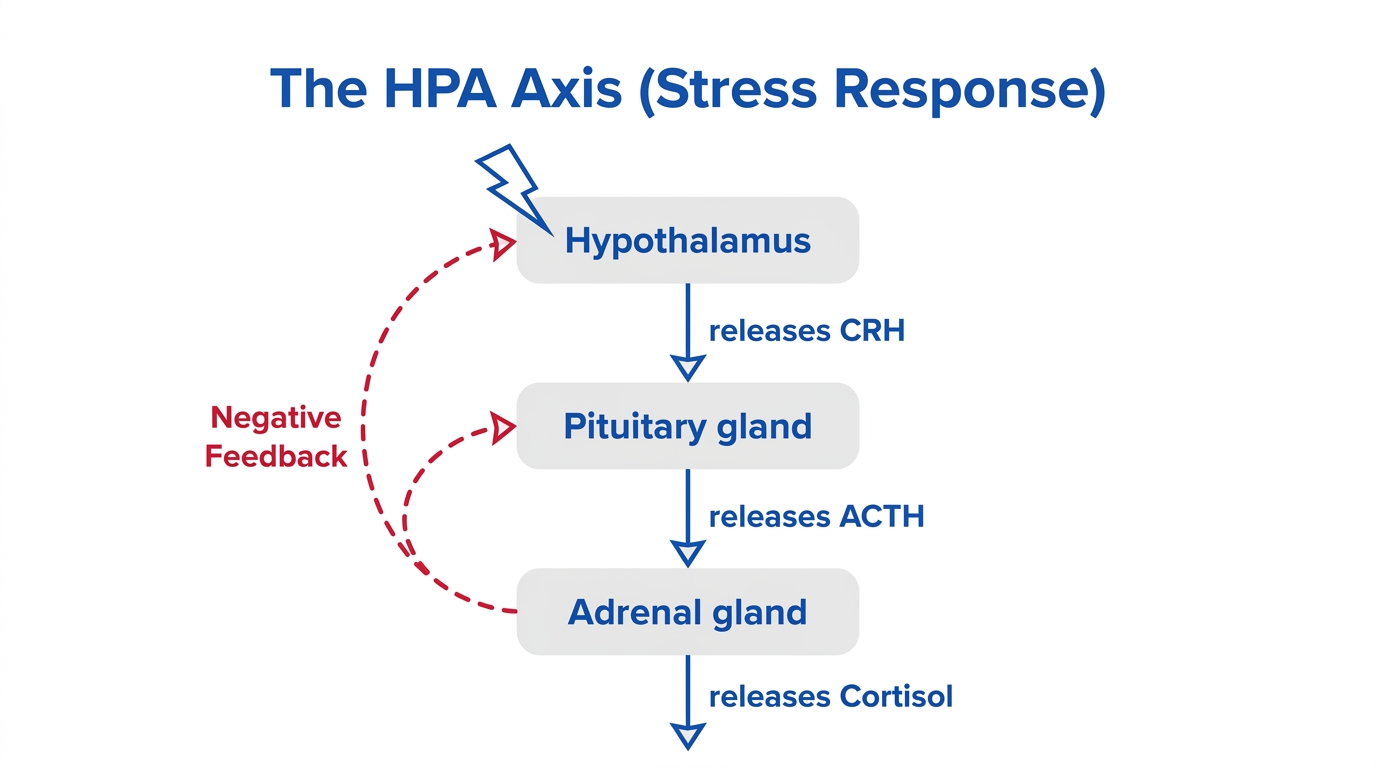
The endocrine system is a network of glands that release hormones into the blood to coordinate growth, metabolism, and reproduction. Two circuits anchor this page: the growth-hormone (GH) axis, where the hypothalamus releases GHRH to prompt the pituitary to secrete GH, and the reproductive axis, where hypothalamic GnRH drives the pituitary to release LH and FSH. The compounds below are studied because each one nudges a specific receptor within these circuits. None of this is medical guidance; it is a summary of what the research literature documents.
How it signals
Peptide hormones work by binding cell-surface receptors, mostly G-protein-coupled receptors, that trigger internal signaling cascades rather than entering the cell. Timing and pattern matter as much as presence: the GH and reproductive axes are naturally pulsatile, and researchers have repeatedly found that steady, continuous exposure to a signal can desensitize a receptor and blunt the very response a brief pulse would stimulate. The studied compounds differ mainly in which receptor they hit, how selective they are, and how long they persist in circulation.
Research peptides studied in this system
Each card summarizes the documented mechanism, what was actually studied and in what model, and how strong the evidence is. These are descriptions of laboratory research — not recommendations, and not evidence of benefit in humans. According to research indexed in PubMed:
What we don’t know — and the risks
Honest limits matter as much as the mechanisms. For this system specifically:
- Research-use-only: none of these compounds are described here for personal use, and this page gives no dosing, timing, route, or administration guidance of any kind.
- Evidence tiers vary widely — hCG and oxytocin are approved medicines with large human datasets, while ipamorelin, the no-DAC CJC-1295 form, and Melanotan II rest mainly on animal or in-vitro data or on uncontrolled human use.
- The GH and reproductive axes are pulsatile and tightly interlinked; pushing one receptor can trigger feedback, desensitization, or downstream hormonal shifts that a single-target description does not capture.
- Unlicensed injectable peptides carry documented safety signals — Melanotan II has been linked in case reports to melanoma and pigmented-lesion change, and purity, dosing accuracy, and contamination are unverifiable outside regulated manufacturing.
- Human efficacy claims should be trusted only where a real human trial supports them; for several compounds the striking data come from short early-phase or animal studies, not long-term outcomes.
- Endocrine questions involving fertility, growth, or hormone balance are clinical matters for a licensed physician, not something to self-manage from mechanism summaries.
Responsible understanding
◆ This is education, not medical advice
This page is educational and describes what has been studied in laboratory and clinical research. It is not medical advice, and these materials are for research use only — not for human or veterinary use. Timing, administration, and whether anything is used at all are clinical decisions that belong with a licensed physician overseeing your care; we take no position on them. Science and regulation evolve; verify anything important against the primary sources below.
Sources
Based on articles retrieved from PubMed. Follow each link to the original paper.
- Teichman SL, Neale A, Lawrence B, Gagnon C, Castaigne JP, Frohman LA Prolonged stimulation of growth hormone (GH) and insulin-like growth factor I secretion by CJC-1295, a long-acting analog of GH-releasing hormone, in healthy adults. The Journal of Clinical Endocrinology and Metabolism. 2006;J Clin Endocrinol Metab. 2006;91(3):799-805. DOI
- Jette L, Leger R, Thibaudeau K, Benquet C, Robitaille M, Pellerin I, Paradis V, van Wyk P, Pham K, Bridon DP Human growth hormone-releasing factor (hGRF)1-29-albumin bioconjugates activate the GRF receptor on the anterior pituitary in rats: identification of CJC-1295 as a long-lasting GRF analog. Endocrinology. 2005;Endocrinology. 2005;146(7):3052-8. DOI
- Memdouh S, Gavrilovic I, Ng K, Cowan D, Abbate V Advances in the detection of growth hormone releasing hormone synthetic analogs. Drug Testing and Analysis. 2021;Drug Test Anal. 2021;13(11-12):1871-1887. DOI
- Grossman A, Savage MO, Besser GM Growth hormone releasing hormone. Clinics in Endocrinology and Metabolism. 1986;Clin Endocrinol Metab. 1986;15(3):607-27. DOI
- Fowkes MM, Lalonde T, Yu L, Dhanvantari S, Kovacs MS, Luyt LG Peptidomimetic growth hormone secretagogue derivatives for positron emission tomography imaging of the ghrelin receptor. European Journal of Medicinal Chemistry. 2018;Eur J Med Chem. 2018;157:1500-1511. DOI
- Venkova K, Mann W, Nelson R, Greenwood-Van Meerveld B Efficacy of ipamorelin, a novel ghrelin mimetic, in a rodent model of postoperative ileus. The Journal of Pharmacology and Experimental Therapeutics. 2009;J Pharmacol Exp Ther. 2009;329(3):1110-6. DOI
- Chan YM Effects of kisspeptin on hormone secretion in humans. Advances in Experimental Medicine and Biology. 2013;Adv Exp Med Biol. 2013;784:89-112. DOI
- Abbara A, Eng PC, Phylactou M, Clarke SA, Mills E, Chia G, Yang L, Izzi-Engbeaya C, Smith N, Jayasena CN, Comninos AN, et al. Kisspeptin-54 Accurately Identifies Hypothalamic Gonadotropin-Releasing Hormone Neuronal Dysfunction in Men with Congenital Hypogonadotropic Hypogonadism. Neuroendocrinology. 2021;Neuroendocrinology. 2021;111(12):1176-1186. DOI
- Latronico AC, Arnhold IJP Inactivating mutations of the human luteinizing hormone receptor in both sexes. Seminars in Reproductive Medicine. 2012;Semin Reprod Med. 2012;30(5):382-6. DOI
- Warne DW, Decosterd G, Okada H, Yano Y, Koide N, Howles CM A combined analysis of data to identify predictive factors for spermatogenesis in men with hypogonadotropic hypogonadism treated with recombinant human follicle-stimulating hormone and human chorionic gonadotropin. Fertility and Sterility. 2009;Fertil Steril. 2009;92(2):594-604. DOI
- Carter CS, Kenkel WM, MacLean EL, Wilson SR, Perkeybile AM, Yee JR, Ferris CF, Nazarloo HP, Porges SW, Davis JM, Connelly JJ, Kingsbury MA Is Oxytocin “Nature’s Medicine”? Pharmacological Reviews. 2020;Pharmacol Rev. 2020;72(4):829-861. DOI
- Eliason NL, Martin L, Low MJ, Sharpe AL Melanocortin receptor agonist melanotan-II microinjected in the nucleus accumbens decreases appetitive and consumptive responding for food. Neuropeptides. 2022;Neuropeptides. 2022;96:102289. DOI
- Ter Laak MP, Brakkee JH, Adan RAH, Hamers FPT, Gispen WH The potent melanocortin receptor agonist melanotan-II promotes peripheral nerve regeneration and has neuroprotective properties in the rat. European Journal of Pharmacology. 2003;Eur J Pharmacol. 2003;462(1-3):179-83. DOI
- Hjuler KF, Lorentzen HF Melanoma associated with the use of melanotan-II. Dermatology (Basel, Switzerland). 2014;Dermatology. 2014;228(1):34-6. DOI
Research-use-only educational content. Nothing here is medical, dosing, timing, or treatment advice.