
 Explore BioBoost Labs
How Peptides Are Made
What a peptide actually is, what it’s made of, and how it becomes the freeze-dried powder in the vial.
What a peptide actually is
A peptide is a short chain of amino acids — the same building blocks your body uses to make proteins. Where a small-molecule drug is a single rigid molecule, a peptide is a sequence: a specific order of amino acids, like letters in a word.
That sequence is the peptide’s identity — change one “letter” and you have a different molecule. Many of the body’s own signals are peptides: insulin, GLP-1, and growth-hormone-releasing hormone are all short amino-acid chains the body makes to carry a message.
What it’s made of
Twenty standard amino acids are the alphabet. Each is joined to the next by a peptide bond, forming a chain with a precise, calculable molecular weight.
Some research peptides are exact copies of a natural human sequence; others are analogs — the natural sequence with deliberate changes that make it more stable or longer-acting. Either way, the compound is fully defined by its sequence and its mass, which is exactly what a lab confirms on a certificate of analysis.
The 20-letter alphabet of life
Every peptide — and every protein your body builds — is spelled from the same twenty amino acids. Change the order and you change the molecule.
How it’s made
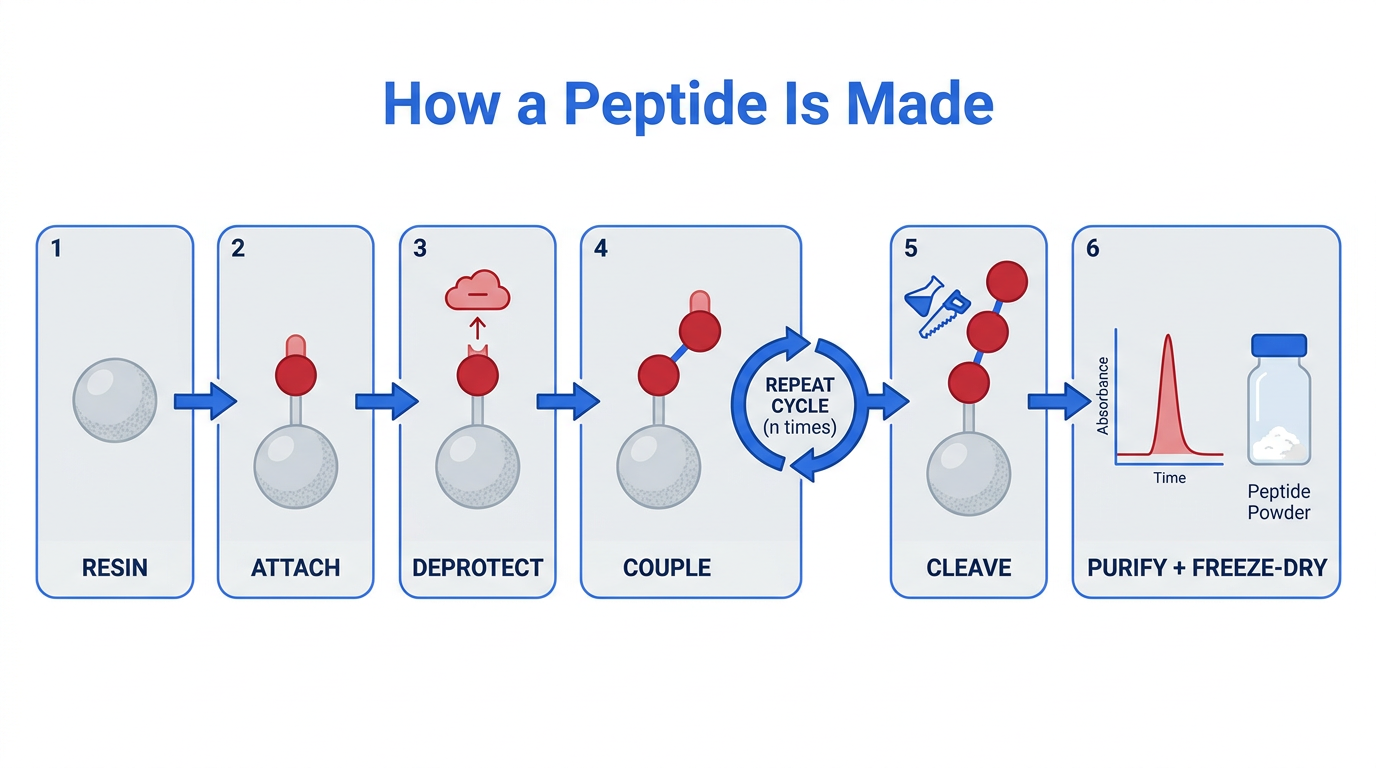
Most research peptides are built by solid-phase peptide synthesis (SPPS) — assembling the chain one amino acid at a time.
The growing chain is anchored to a tiny solid resin bead. A protected amino acid is coupled on, its protecting group is removed, the next amino acid is coupled, and the cycle repeats — residue by residue — until the full sequence is complete. Longer or more complex peptides can instead be produced by recombinant expression: engineering bacteria or yeast to manufacture the sequence biologically. Both are precise, well-established chemistry — not something mixed up in a back room.
From synthesis to the powder in the vial
This is the part people ask about most: why is it a powder?
Once the chain is complete, it’s cleaved off the resin and then purified — typically by reverse-phase HPLC, which separates the target peptide from trace by-products. The purified peptide is then freeze-dried (lyophilized): frozen and placed under vacuum so the water sublimates straight away, leaving the light, dry powder you see in the vial. That’s why it arrives as a powder and has to be reconstituted — it’s the pure peptide with the water removed so it stays stable in storage. The handling & reconstitution guide covers adding it back.
Go deeper
Open any step to see how it actually works.
The synthesis cycle, one residue at a time
Why freeze-drying (lyophilization)?
Mass spectrometry vs HPLC — identity vs purity
What makes an “analog”?
See a real peptide in 3D
This is insulin — one of the peptides your own body makes. Drag to rotate its actual atomic structure, solved by X-ray crystallography.
How you know it’s really that peptide
Because a peptide is fully defined by its sequence and mass, a lab can verify exactly what’s in a vial.
Mass spectrometry confirms the molecule is the right one (its measured mass matches the sequence), and HPLC measures how pure it is. That is what a certificate of analysis reports — see how a peptide is identified & tested in a lab.
◆ The how, not the whether
This page explains how peptides are made — not who should use anything, or how. These are research materials for laboratory research only; any decision about personal use belongs with a licensed physician. For what a specific compound is and does, open it in the interactive Bio-Scan or browse the Research LibraryReference Log.
Research-use-only educational content. Nothing here is medical, dosing, timing, or treatment advice.